In the world of home renovation, there is a common misconception that high-end appliances or custom cabinetry are the primary drivers of kitchen value. While those elements are important, they are not the “workhorses” of the room. The countertop is the surface that dictates the daily experience, withstands the most physical stress, and serves as the visual centerpiece of the home.
As we move through 2026, the debate between Quartz vs. Granite remains at the forefront of every high-value remodel. Both materials are synonymous with luxury, but they offer different types of value—one rooted in modern engineering and the other in natural, geological art. Understanding which material aligns with your lifestyle and your home’s architecture is the key to making a strategic investment that pays off for years to come.
Key Takeaways
- Maintenance Profiles: Quartz is non-porous and maintenance-free, while granite requires periodic sealing to remain stain-resistant.
- Aesthetic Appeal: Granite offers one-of-a-kind natural patterns; quartz provides contemporary consistency and a wider range of solid colors.
- Durability Factors: Both are incredibly hard, but quartz is more flexible (less prone to chipping), while granite is superior in heat resistance.
- Resale Trends: Modern buyers in 2026 increasingly favor quartz for its “move-in ready” and “low-effort” reputation.
- Market Alignment: Granite often adds more value to traditional or rustic homes, whereas quartz is the gold standard for modern and transitional designs.
- Fabrication Impact: The ROI of either stone is only realized through precision installation and digital templating.
- Long-Term Asset: A well-chosen countertop is one of the few kitchen upgrades that can offer a near-total return on investment during a home sale.
What Is the Value Difference?
Value in a home is measured in two ways: Functional Value (how it improves your life today) and Resale Value (how much it increases the asking price tomorrow).
Quartz provides high functional value for busy families because it resists bacteria and doesn’t require the chore of resealing. Granite provides high emotional value, offering a “luxury” feel that comes from knowing no other kitchen in the world has that exact slab. In 2026, the market is split: approximately 60% of buyers prefer the convenience of quartz, while 40% remain loyal to the prestige and heat-tolerance of natural granite.
Why Is Understanding the Comparison Important?
Choosing the wrong material can lead to “renovator’s remorse.” If you put high-maintenance granite in a rental property or a home with small children, the surface may suffer from neglect. Conversely, putting a highly uniform quartz in a historic home might feel “out of place.” Understanding the nuances of these two titans ensures your budget is spent on a material that complements the home’s “story.”
How Do Quartz and Granite Compare?
| Feature | Quartz (Engineered Stone) | Granite (Natural Stone) |
| Composition | ~93% Quartz, 7% Resin/Pigment | 100% Natural Rock |
| Porousness | Non-Porous (Hygenic) | Porous (Requires Sealant) |
| Heat Resistance | Moderate (Use Trivets) | Excellent (Heat-Proof) |
| Pattern | Predictable & Uniform | Unique & Randomized |
| Repairability | Hard to repair chips | Easier to fill with epoxy |
| Cleaning | Soap and water | Stone-specific cleaners only |
Phases of the Value-Addition Process
1. Market and Style Analysis
Before selecting a stone, evaluate your neighborhood. If most homes in your area feature modern renovations, quartz is the safer bet for value. If you live in a high-end luxury estate where “natural materials” are a requirement, a rare granite slab may actually command a higher premium.
2. Selection and Slab Inspection
For quartz, you can often choose from a sample. For granite, we highly recommend visiting the yard to see the specific slab. Because granite is a product of nature, the “movement” and colors can vary wildly from one end of the stone to the other.
3. Digital Laser Templating
The value of the material is lost if the seams are thick or the overhang is uneven. We use digital laser scanners to create a “blueprint” of your cabinets. This ensures that when the stone arrives, it integrates perfectly with your walls, sinks, and appliances.
4. CNC Fabrication
Our advanced CNC (Computer Numerical Control) machinery handles the heavy lifting. By using water-jets and diamond-tipped tools, we achieve edges and cutouts that are physically impossible to replicate by hand. This precision is what gives your kitchen that “custom-built” feel.
5. Professional Installation & Sealing
If you choose granite, the final step includes a high-grade professional sealer to protect your investment. For both materials, our installation team ensures the stone is perfectly level, preventing future cracks or stress fractures.
What Factors Affect Countertop ROI?
- The Edge Profile: A simple “Eased” edge is timeless and adds value by not going out of style. Complex edges like “Ogee” can be beautiful but are more subjective to buyer taste.
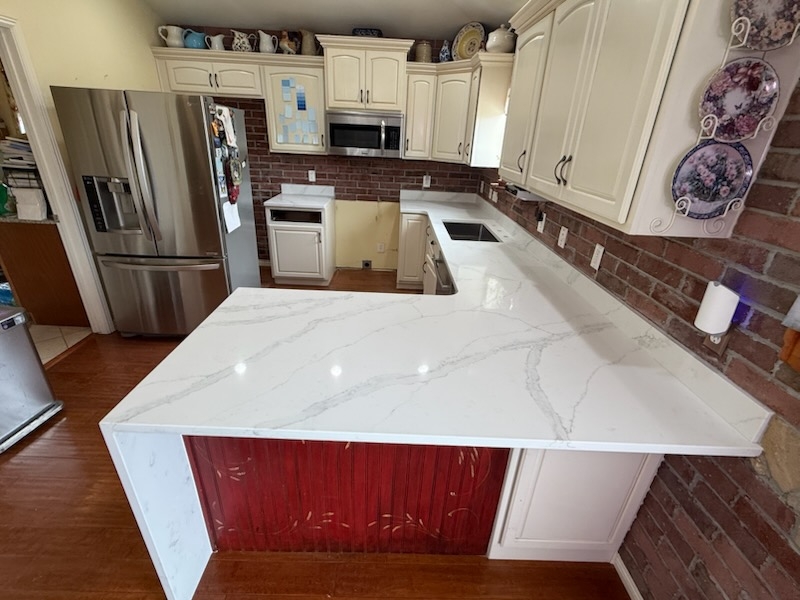
- Seamless Transitions: In 2026, the “Waterfall” edge (stone running down the side of the island to the floor) is the single highest value-add in kitchen design.
- Color Neutrality: While a blue granite might be stunning, neutral tones like whites, greys, and charcoals have a much broader appeal during resale.
How Can You Maximize Your Home’s Value?
- Match the Backsplash: Using the same material for the countertop and the backsplash (a “full-height splash”) is a premium upgrade that makes the kitchen look twice as expensive.
- Under-Mount Sinks: Always pair high-end stone with an under-mount sink. It creates a seamless look and makes cleaning much easier, a feature buyers always look for.
- In-House Quality: Avoid big-box retailers who outsource their labor. Value is created when the fabricator who cuts the stone is the same one who installs it, ensuring accountability and precision.
What Tools Help You Decide?
- Resale Calculators: Look at local real estate listings to see which material is mentioned more frequently in “recently renovated” descriptions.
- Visualizer Software: Use digital tools to see how quartz looks versus granite in your specific kitchen layout.
- Salt Stone Consultations: Our experts can show you how different stones react to light and use in a real-world setting.
What Should You Do Next?
- Assess Your Lifestyle: Are you a “messy” cook who leaves lemon juice or wine on the counter? Go with Quartz. Do you frequently take hot pans directly off the stove? Go with Granite.
- Check Your Timeline: If you are selling in 1-2 years, choose the most popular local trend. If you are staying for 10+ years, choose the material you love most.
- Get a Precision Quote: Start with a professional estimate that covers the full scope of the project.
Conclusion
Whether you choose the engineered perfection of quartz or the timeless, rugged beauty of granite, you are making a choice that elevates your home’s standing in the market. In 2026, value is defined by the intersection of durability and aesthetics. A countertop isn’t just a place to chop vegetables; it is a long-term asset that defines the quality of your home.
At Salt Stone Fabrication & Design, we don’t just sell stone; we provide precision. By controlling the entire process—from digital laser templating to CNC fabrication—we ensure that your quartz or granite project is executed with 100% accuracy. We believe that true home value is found in the details: the invisible seams, the perfectly polished edges, and the peace of mind that comes from a flawless installation.
Invest in a surface that works as hard as you do.